


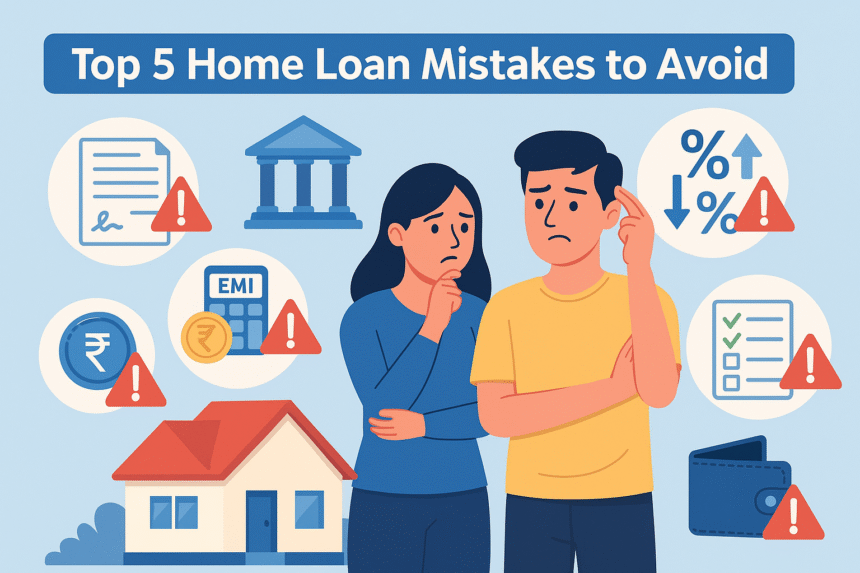
Buying a house is a dream. Taking a home loan? Often a long-term financial commitment that spans decades. And yet, many people walk into it without doing the homework, leading to financial stress, hidden charges, or even loan rejection.
In this guide, we break down the Top 5 Mistakes that people commonly make while taking a home loan – and how you can avoid them smartly.
🏦 Mistake #1: Not Comparing Loan Offers from Multiple Banks
One of the biggest blunders people make is walking straight into the bank where they already have a savings account — assuming they’ll get the best deal. Wrong.
Why it matters:
Every bank has different interest rates, processing fees, loan tenure flexibility, and customer service experience.
Even a 0.25% difference in interest rate can lead to lakhs in savings over the loan’s tenure.
🔍 Example:
Let’s say you borrow ₹50 lakhs for 20 years.
- Bank A interest: 8.5%
- Bank B interest: 8.25%
Over 20 years, Bank A’s EMI is ₹43,391 while Bank B’s is ₹42,728 — that’s a total difference of ₹1.59 lakhs.
✅ What to do:
- Use online comparison tools like BankBazaar, PaisaBazaar, or your bank’s EMI calculators.
- Negotiate with banks; many offer preferential rates for salaried, women, or existing customers.
🧾 Mistake #2: Ignoring the Actual EMI Affordability
Most people are fixated on the loan amount the bank is willing to sanction, not on what they can realistically repay monthly.
This is a recipe for EMI pressure and future defaults.
Why it matters:
Banks use the FOIR (Fixed Obligations to Income Ratio), but that doesn’t consider your lifestyle costs, kids’ education, or emergencies.
✅ Rule of Thumb:
Your total EMIs (including existing loans) should not exceed 40% of your net monthly income.
🧠 Smart Tip:
If you’re eligible for ₹60 lakhs, but your budget comfortably allows EMIs for ₹45 lakhs — stick to ₹45 lakhs.
Over-borrowing = Over-burdening.
🧨 Mistake #3: Ignoring Hidden Charges and Loan Terms
It’s easy to get attracted by low interest rates and quick approvals. But many don’t read the fine print that includes:
- Processing fees
- Legal and technical charges
- Prepayment or foreclosure penalties
- Switching charges if you want to move to another lender later
📌 Real-life Scenario:
Arjun took a ₹40 lakh loan with 8.75% interest. Later, another bank offered 8.25%. But switching meant:
- ₹10,000 for legal revaluation
- ₹5,000 switching fee
- 1% penalty from original bank
He ended up losing money instead of saving it.
✅ What to do:
- Ask for an all-inclusive cost sheet.
- Clarify charges for part-prepayment, foreclosure, late EMIs, and switching lenders.
- Prefer banks that offer no prepayment charges for floating-rate loans (as per RBI guidelines).
🧠 Mistake #4: Not Considering the Type of Interest Rate
Most borrowers don’t understand the difference between fixed and floating interest rates — and choose based on what feels “safe.”
📉 Fixed Rate:
- EMI remains constant throughout the tenure.
- Generally higher than floating rates.
- Good in rising interest rate environments.
🌊 Floating Rate:
- EMI changes with market-linked benchmark (like repo rate).
- Usually cheaper initially.
- Ideal in stable or falling interest rate periods.
✅ What to do:
- If you expect rates to fall or stay flat, go with floating.
- If you’re risk-averse and want stability, opt for fixed or hybrid schemes.
Bonus Tip:
Ask about reset frequency on floating rates — many banks only reset annually, delaying benefits.
❌ Mistake #5: Not Factoring in Insurance and Emergency Buffer
Banks often club home loan insurance into your EMI — which sounds helpful, but it increases your loan burden.
Also, many borrowers don’t keep an emergency fund, assuming nothing will go wrong.
Why it matters:
- A job loss, accident, or illness can disrupt your EMI payments.
- Without insurance or a buffer, you risk defaulting and losing the house.
✅ What to do:
- Keep a 6-month EMI reserve as an emergency buffer.
- Explore term insurance separately — it’s cheaper than bundled plans banks offer.
- Consider home loan protection plans only if affordable and clearly explained.
🏁 Summary Table: Top 5 Mistakes vs. Smart Alternatives
| ❌ Mistake | ✅ Smart Alternative |
|---|---|
| Not comparing banks | Use online tools and negotiate |
| Borrowing maximum limit | Borrow what you can comfortably repay |
| Ignoring hidden charges | Get a full cost breakdown upfront |
| Choosing wrong interest type | Understand fixed vs floating and choose wisely |
| No insurance or buffer | Keep emergency funds and buy term insurance |
📣 Bonus Mistakes Worth Avoiding
- Not checking your CIBIL score before applying
- Rushing into under-construction properties without due diligence
- Falling for subvention schemes or “no EMI till possession” traps
- Not factoring stamp duty and registration charges
💬 Final Thoughts
Taking a home loan is not just about interest rates — it’s about financial planning, emotional readiness, and smart decision-making.
By avoiding these 5 mistakes, you can turn your dream home into a stress-free reality rather than a debt trap.
🧠 “A well-planned home loan is the first brick of your financial freedom. A badly planned one is a long-term liability.”
📌 Action Checklist Before You Apply:
- ✅ Check your CIBIL score (aim for 750+)
- ✅ Calculate your EMI limit based on income
- ✅ Compare offers from 3–5 lenders
- ✅ Ask for a full cost sheet including hidden charges
- ✅ Build an EMI reserve fund